
LE cell phenomenon (Lupus erythematosus cell)
LE cell phenomenon
What sample is needed for the LE cell phenomenon?
- 5 to 10 mL of venous blood from the patient is taken and traumatized with a glass rod or glass beads.
What are the Indications for the LE cell phenomenon?
- This is done to diagnose Systemic lupus erythematosus. (SLE).
What are the signs and symptoms of Systemic lupus erythematosus?
- Systemic symptoms like fever, malaise, and inflammation of serous membranes like the pericardium.
- Facial skin rash.
- Arthritis.
- Renal diseases like nephritis.
- SLE is more common in females, predominantly young or middle-aged adults.
- In one study, the mean age was 30 (the majority between 14 and 40 years).
- Fewer patients were seen between the ages of 40 and 55 years.
- Few cases were seen in infancy to 14 years and over 55 years.
- Hepatomegaly was seen in 30% of the cases.
- Splenomegaly was seen in 20% of the cases.
- Lymphadenopathy was seen in 50% of the cases.
What are the Lab findings of SLE?
- Anemia is present in 60% to 75% of the cases.
- Anemia is mild to moderate, normocytic, and normochromic.
- <10% develop autoimmune hemolytic anemia.
- Leucopenia is seen in 50% of the patients.
- 15% may develop thrombocytopenia.
- 30% of the patients have positive direct Coombs test.
- There may be abnormal plasma proteins like:
- Cold-precipitable cryoglobulins.
- Circulating anticoagulants.
- Autoantibodies.
- Circulating immune complexes.
- Raised gamma-globulins.
- Syphilis serologic reactions.
- False positive RA factor.
- Some rare phenomena.
- In active nephritis, C3 and C4 are decreased.
What type of autoantibodies are seen in SLE?
| Autoantibodies | Type of antibodies |
|
|
|
|
|
|
|
|
|
|
|
|
How will you discuss the pathophysiology of the LE cell phenomenon?
- Systemic lupus erythematosus is a typical autoimmune disease.
- It is a systemic rheumatic disease.
- The etiology is unknown, but the primary defect is in the immune system.
- 50 to 70 new cases are diagnosed per year per million people.
- The range of the disease is:
- Mild, limited to a photosensitive facial rash and transient diffuse arthritis.
- Life-threatening involvement of:
- Kidneys.
- Cardiovascular system.
- Respiratory system.
- Central nervous system.
What is the mechanism of the LE cell phenomenon?
- A LE cell is either a normal segmented white blood cell or another phagocytic cell with an engulfed homogeneous and swollen nucleus.
- This is a degenerating nucleus, which may be in white blood cells or lymphocytes.
- In SLE, there are various self-antigens like:
- Nuclear histones and proteins.
- IgG
- RBCs
- DNA and RNA
- Platelets.
What is the mechanism of injury in SLE?
- Autoantibodies form against all the above antigens.
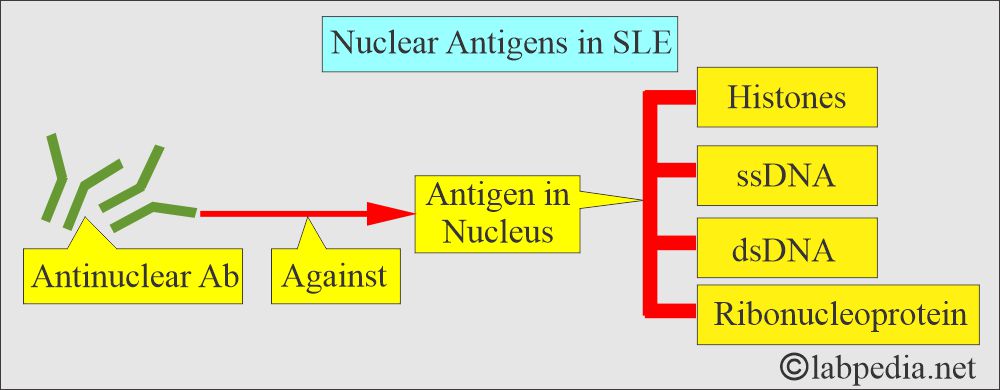
SLE antigens
- Autoantibodies give rise to an Ag+Ab complex, leading to damage by Type 3 and Type 2 hypersensitivity reactions.

SLE Antigen and Antibody reaction
- Antinuclear antibodies cause damage to the nucleus, which degenerates and gives rise to a homogeneous body called a hematoxylin body.
- Mature neutrophilic polymorphonuclear leukocyte phagocytizes a spherical, homogeneous-appearing inclusion (hematoxylin body).
- This is a neutrophil leucocyte with a homogeneous red-purple inclusion that distends the cell and pushes the nucleus to one side.
- This inclusion is derived from the nuclear material of degenerating leukocytes as the outcome of antibodies against the nuclear material.
- These inclusions are characteristic of lupus erythematosus but are also found in other autoimmune diseases.
What is the procedure for the LE Cell Phenomenon?
- Take 5 to 10 mL of blood.
- Add glass beads or traumatize the cells with a glass rod.
- Incubate for 20 to 30 minutes at 37 °C.
- LE cells form during incubation.
- Bone marrow may be taken for this phenomenon.
- Centrifuge the blood sample and make a slide from the buffy coat or the area of the white cells.
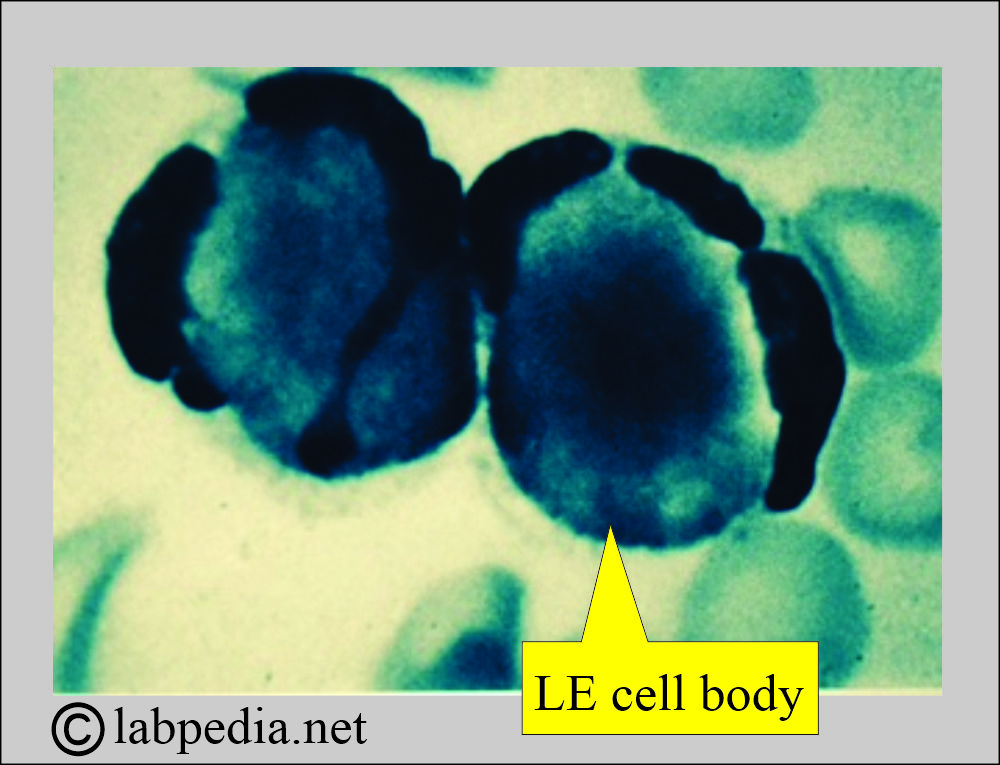
LE Cell Body
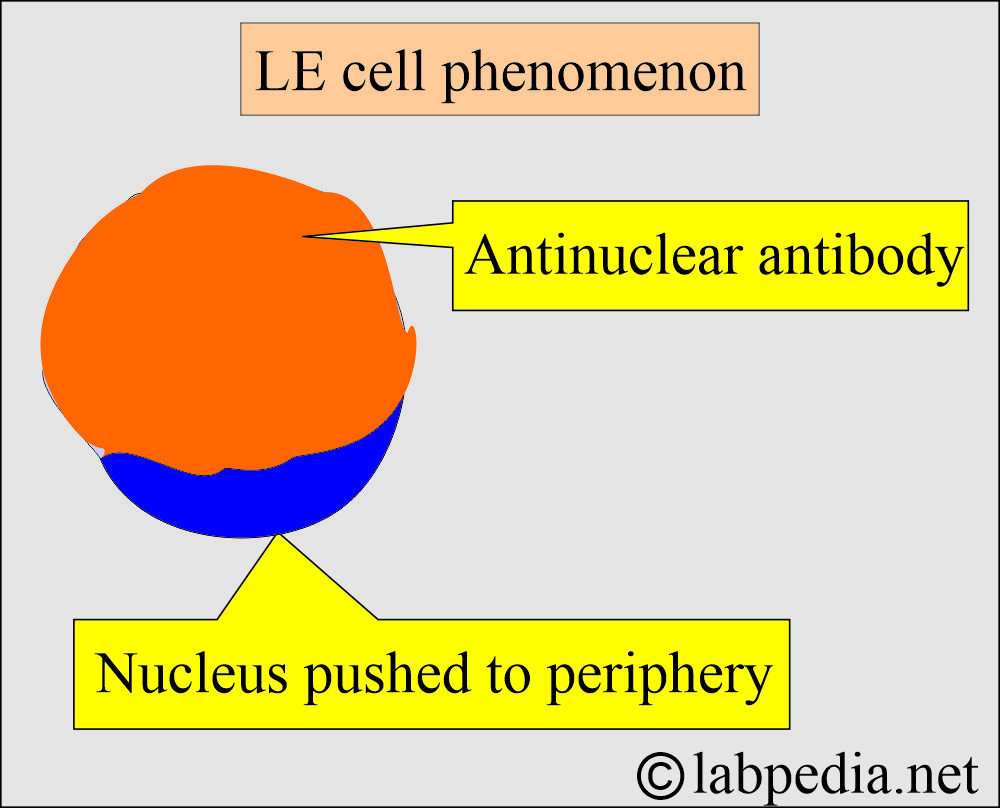
LE cell phenomenon
What is the result of the LE cell phenomenon?
- The neutrophils show intracytoplasmic inclusions, pushing the homogeneous degenerated nucleus to the periphery.
- LE cells may be found in CSF, Joint, pleural, pericardial fluid, and blister fluid smears.
- Now, this test is obsolete because of so many other diagnostic tests.
What are the conditions where Positive LE cells are seen?
- Systemic lupus erythematosus. These are positive in 95% of the cases.
- Drug-induced lupus erythematosus. These are seen in 80% to 95% of cases.
- Other autoimmune diseases show LE cells in less than 20% of the cases.
Questions and answers:
Question 1: What are hematoxylin bodies?
Question 2: What is the mechanism of injury in SLE?
???
Thanks