
Urine Formation, Types of Urine, and Urine Preservatives
Urine formation
How will you define Urine?
- kidneys filter large amounts of plasma and reabsorb most of it, which is filtered and leaves behind the unwanted metabolic waste to be eliminated is called urine
- The kidneys form urine, passes through the ureters, and is stored in the urinary bladder.
- Normal urine specific gravity is around 1.024, and the color is clear.
How does urine formation take place?
- Urine formation takes place in three steps:
- Ultrafiltrate formation from the glomeruli from the plasma.
- Reabsorption of the water and solutes from the ultrafiltrate.
- Secretion of the extra solutes into the tubular fluid, like urine.
What is the function of kidneys in urine formation?
- Urine formation.
- Protein conservation.
- Regulation of acid-base balance.
- Regulation of fluid and electrolyte balance.
- Hormonal function.
- Removal of potentially toxic material is one of the main functions of the kidneys.
What is the role of nephrons in urine formation?
- Ultrafiltration is a protein-free plasma filtrate.
- Maintain the body fluid volume.
- Maintain the balance of the composition of the electrolytes.
- Maintain the pH.
What is the role of tubular reabsorption process in urine formation?
- This is the movement of fluids and substances from the tubular lumen to the peritubular capillary plasma.
Tubular Reabsorption:Mode of transport Substances Site of reabsorption - Active transport
- Sodium (Na)
- Proximal and distal convoluted tubule
- Chloride (Cl–)
- The ascending loop of Henle
- Glucose, salts, and amino acids
- Proximal convoluted tubule
- Passive transport
- Urea
- Proximal convoluted tubule
- The ascending loop of Henle
- Sodium (Na+)
- The ascending loop of Henle
- Water (H2O)
- Proximal convoluted tubule
- Descending loop of Henle
- Collecting tubules.
What is the tubular secretion process in urine formation?
- This is the transfer of substances and fluids from the plasma of the peritubular capillaries to the tubular lumen.
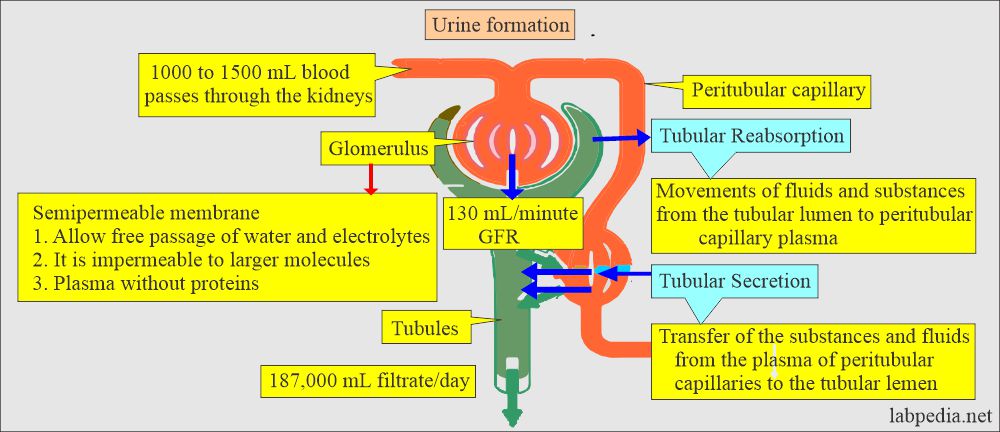
Urine formation process
Tubular secretion process in urine formation:
| Substances | Site of secretion |
|
|
|
|
|
|
|
|
|
|
|
|
|
|
|
|
Chemical substances and their excretion and absorption in the renal system:
| Chemical substance | After filtration | Reabsorption g/24 hours | Excreted g/24 hours |
|
|
|
|
|
|
|
|
|
|
|
|
|
|
|
|
|
|
|
|
|
|
|
|
|
|
|
|
|
|
|
|
- Each day, an average of 115 to 180 L for females and 130 to 200 L of fluids for men were filtered through the glomeruli.
- Water 180 L is filtered, 178.2 L is reabsorbed, and only 1.5 L is excreted daily.
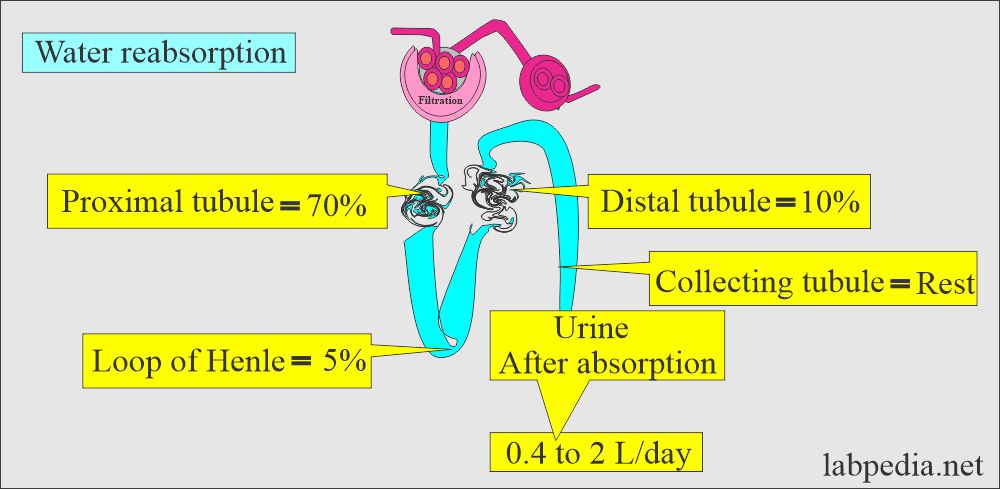
Urine water reabsorption
- Sodium 25,200 meq/day is filtered, 25050 is reabsorbed, and only 150 meq is excreted daily.
- Potassium 720 meq/day is filtered, 620 is reabsorbed, and only 100 meq is filtered per day.
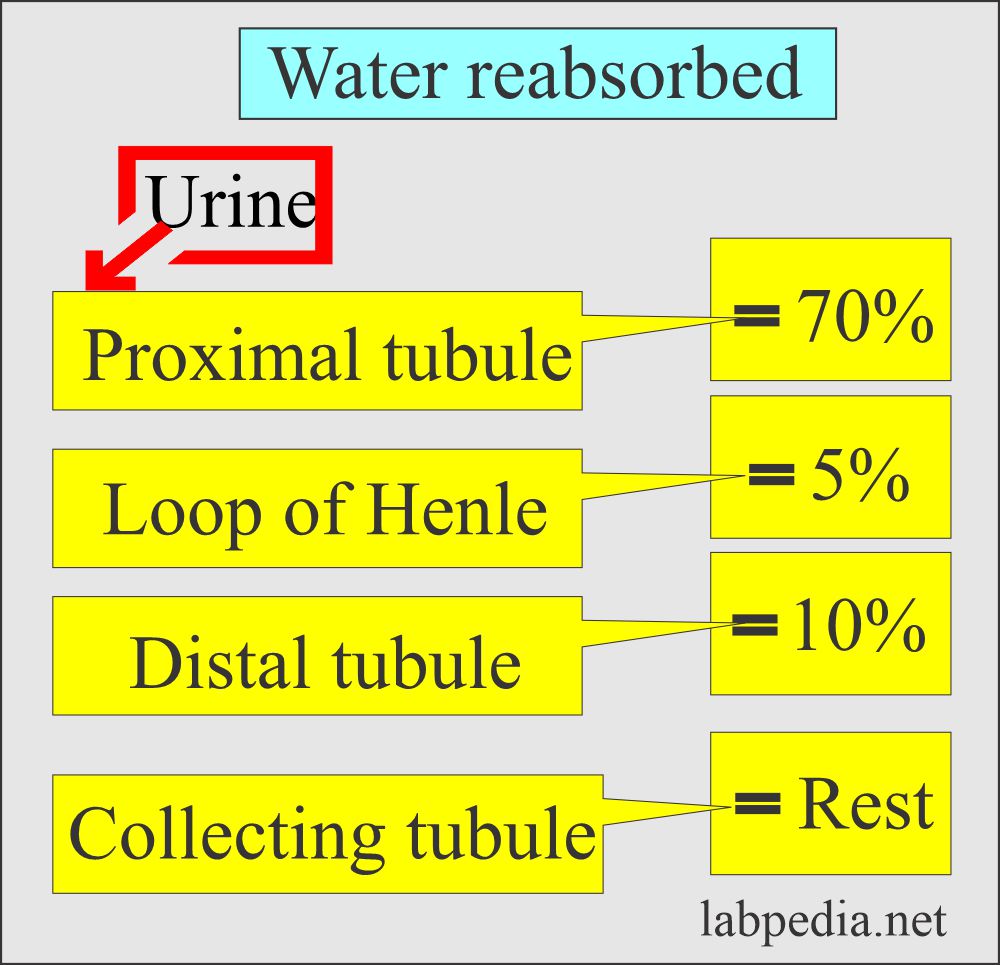
Urine water reabsorption
How will you summarize urine formation and functions of the kidney?
- The process of absorption needs metabolic energy to do active reabsorption.
- This process is against the gradient, so it needs energy.
- The kidneys regulate the active reabsorption of glucose, amino acids, low-molecular-weight protein, sodium, calcium, magnesium, potassium, uric acid, chloride, and bicarbonate according to the level of these substances in the blood and the body’s needs.
- Passive reabsorption occurs when substances move by simple diffusion due to an electrical or chemical concentration gradient.
- No cellular energy is involved in this process.
What is the role of the proximal tubules in urine formation?
- Proximal tubular cells perform various physiologic functions for the formation of urine.
- About 80% of salts and water are reabsorbed from the glomerular filtrate in the proximal tubules.
- All glucose and amino acids are reabsorbed.
- The plasma glucose level is completely reabsorbed and does not appear in the urine.
- The higher the plasma concentration of the glucose, the greater the quantity of glucose excreted in the urine.
- Unless it crosses renal thresholds.
- Low-molecular-weight substances are reabsorbed to some extent like:
- Protein.
- Urea.
- Uric acid.
- Chloride, bicarbonate, phosphate.
- K+, Ca++, Mg++.
- Secreted into a tubular fluid by the tubular cells are:
- Organic acids.
- Bases.
- H+ ions.
- Ammonia (NH3).
What is the role of Tubular Secretion in urine formation?
- There is the transport of the substances into the tubular lumen.
- This process is opposite to tubular reabsorption.
- This may be an active or passive process.
- Substances that are transported from blood to the tubules and excreted in the urine include potassium (K+), ammonia, uric acid, certain drugs (penicillin), and hydrogen ions (H+).
What is the role of Loop of Henle in urine formation?
- The descending loop of Henle is highly permeable to water.
- The loop of Henle is increasingly hypertonic.
- Urine is highly concentrated at the bottom of the loop.
- The ascending limb is relatively impermeable to the passage of the water but actively absorbs sodium (Na+) and chloride (Cl–).
- The ascending limb of the loop of Henle transfers sodium chloride (Na+Cl–) actively from its limen into the interstitial fluid.
- The tubular fluid in the lumen is hypotonic, and interstitial fluid becomes hypertonic.
What is the role of Distal convoluted tubule in urine formation?
- A small fraction of the filtered sodium (Na+), Chloride (Cl+), and water are reabsorbed in the distal convoluted tubule.
- The distal convoluted tubule responds to ADH (anti-diuretic hormone).
- Distal convoluted tubule permeability for water increases in the presence of ADH. It will be low in the absence of the ADH hormone.
- Potassium (K+) is reabsorbed or secreted in the distal tubule.
- Aldosterone stimulates sodium (Na+) reabsorption and potassium (K+) secretion in the distal tubule.
- Hydrogen (H+), ammonia, and uric acid secretion occur in the tubule. At the same time, bicarbonate is reabsorbed in the tubule.
What is the role of collecting ducts in urine formation?
- ADH (anti-diuretic hormone) controls the water permeability of collecting tubules in all its length.
- In the presence of ADH, a hypotonic tubular fluid entering the ducts loses water.
- Sodium (Na+) and chloride (Cl+) are reabsorbed in the collecting duct.
- The collecting duct also reabsorbed potassium (K+), ammonia (NH3), and Hydrogen (H+).
- The collecting duct is relatively impermeable to urea.
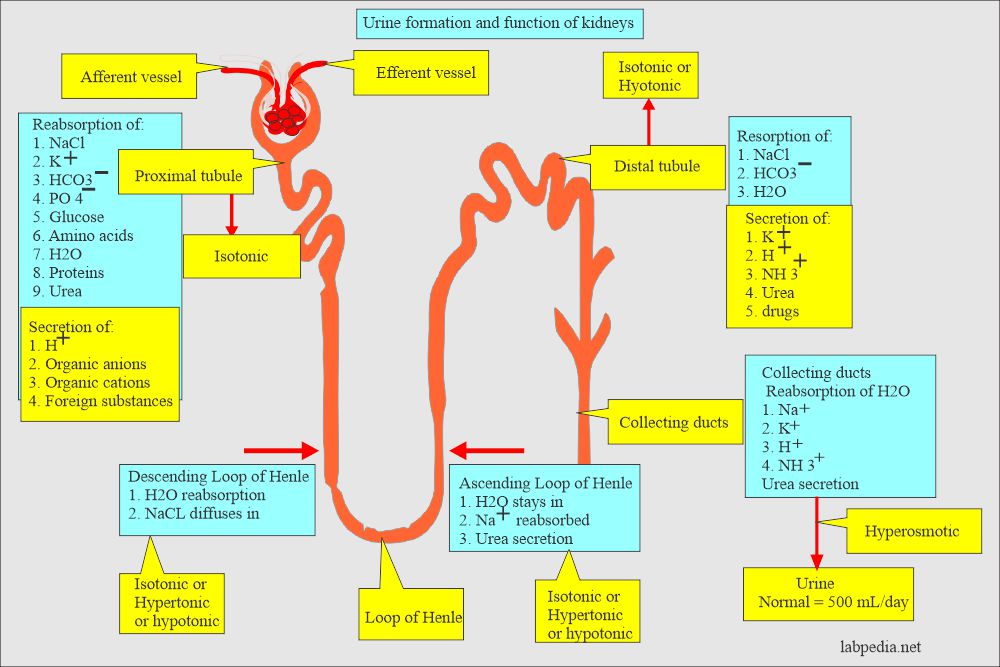
Urine formation in kidneys
How will you summarize the Urine formation?
| Chemical substances | Quantity filtered/day | Quantity excreted/day | Amount reabsorbed |
|
|
|
|
|
|
|
|
|
|
|
|
|
|
|
|
|
|
|
|
|
|
|
|
|
|
|
|
What are the types of Urine samples?
- Random Sample:
- This is collected without any precaution and may be collected at any time of the day.
- This may be collected for the drug abuse analysis.
- Morning sample:
- This is the first sample when the patient gets up in the morning.
- This is concentrated urine.
- This is the choice of sample for microscopic examination.
- This is also the sample choice for the urine constituents to detect protein, HCG, and other substances.
- 8 hours sample:
- This may be an alternative to the first-morning sample because this will also be concentrated in the urine.
- 24-hour sample:
- This sample is used to quantify any urine solutes like proteins to avoid that substance’s diurnal variation.
- Instruct the patient to void the first sample and note the time. After that, all the samples will be collected until 24 hours have passed.
- Now, void the last sample in the container.
- 24 hours of samples are used for the substances with diurnal variations like catecholamines, 17-hydroxysteroids, and electrolytes.
- Timed Specimen:
- These samples are collected at a predetermined time, like 1,4, or 24 hours.
- A sample patient is given special diet or drug-use instructions for a collection of times.
- Clean catch sample:
- In this case, the patient is instructed to clean the genitalia with water and soap.
- Then, the midstream sample is collected.
- These are used for the bacteriological culture.
- Caution should be taken that the container should not touch the genitalia.
- Catheter samples:
- These are usually collected from seriously ill patients who are already catheterized.
- Or insert the catheter into the urinary bladder to collect the sample.
- These are used for the microbiological examination of critically ill patients.
- Suprapubic sample:
- The sample is directly collected from the urinary bladder using a suprapubic needle that has been completely sterilized.
- This sample is ideal for the culture, and there is a bypass of the urethra.
- This will be a good sample for the culture of the urinary bladder.
- This is usually done from the distended urinary bladder.
- Urine from children:
- Collecting the samples from infants is difficult.
- There are adhesive bags available to put on the urethra to collect urine.
What are the types of urine and their indications?
| Type of urine sample | Indications |
|
|
|
|
|
|
|
|
|
|
|
|
|
|
|
|
|
|
|
|
What are the Urine preservatives?
What is the role of urine preservatives?
- These preservatives are added for the following purposes:
- Reduce bacterial growth.
- Decrease the decomposition of the chemicals.
- Keep the substance in solute form.
- Decreases the atmospheric oxidation of unstable compounds.
- Refrigeration is the most useful tool for collection, and its utility increases with adding preservatives.
- The tablets commercially available are:
- Potassium acid phosphate.
- Sodium benzoate.
- Benzoic acid.
- Methenamine.
- Sodium bicarbonate.
- Red mercuric acid.
What are the advantages of preservatives?
- These tablets act mainly by lowering the pH of urine and releasing formaldehyde.
- Formalin is used as a preservative, but in large amounts, it precipitates urea and inhibits some chemical reactions.
- Acidification of the urine below pH 3 is widely recommended. This is widely used to preserve urine for 24 hours and is particularly useful for calcium, steroids, and vanillylmandelic acid determination. HCL 10 mL, 6 mol/L per 24 hours of urine is used.
- Sulfamic acid is used at 10 g/L to reduce the pH.
- Boric acid is used at 5 mg/30 mL, but it causes precipitation of the urates.
- Toluene is only an organic preservative and is still used; this will not prevent anaerobic microorganisms’ growth.
- Sodium carbonate is used at 5 g/for 24 hours urine sample to preserve the porphyrins and urobilinogen.
What are the various urine preservatives?
Refrigeration:
- When there is a delay in examining urine, refrigerate at 2 C to 8 C.
- Urine can be freezed at -24 C to -16 C.
- If urine collection for the examination is delayed by more than 2 hours, it needs preservatives.
- When urine is refrigerated:
- This will not interfere with the urine chemical tests.
- It prevents bacterial growth.
- Refrigerate for albumin, aldosterone, amylase, chloride, cortisol, estradiol, FSH, lipase, oxalate, protein, and uric acid.
- The disadvantage is there is an increase in the specific gravity.
- Precipitate amorphous phosphates and urates.
HCl (Hydrochloric acid):
- Add 6 mL of hydrochloric acid (HCL) for Aldosterone, calcium, creatinine, cystine, homovanillic acid, 17-ketosteroids, oxalate, and VMA.
Boric acid:
- It will preserve protein.
- Preserves formed elements.
- It will not interfere with the routine examination except for the pH.
- This is bacteriostatic.
- Add boric acid for albumin, cortisol, estrogen, aldosterone, amino acid, chloride, HCG, citrate, cortisol, creatine, DHEA, FSH, glucose, phosphate, 17- Ketosteroids, protein, uric acid, and zinc.
- The disadvantage is that it may precipitate crystals when used in large amounts.
- It interferes with drugs and hormones.
Formalin (formaldehyde):
- It is the best for urine sediments.
- It acts as a reducing agent.
- Rinse the container with formalin to preserve the cells and casts.
- The disadvantage:
- It interferes with chemical tests like glucose, esterase, blood, and white blood cells.
Sodium fluoride:
- It prevents glycolysis.
- This is a good preservative for the drug’s analysis.
- The disadvantage:
- It will interfere with test strips for glucose, white blood cells, and red blood cells.
Phenol:
- It does not interfere with routine tests.
- It changes the odor.
- Use one drop of phenol per ounce of urine.
Toluene:
- It does not interfere with routine tests.
- The disadvantages are that it floats over the surface of the urine and may block the pipette.
Thymol:
- It is an excellent preservative for glucose and sediments.
- The disadvantage:
- It interferes with acid precipitation for the protein.
Commercial preservative tablets:
- It is easy to use when refrigeration is not available.
- Check the tablets’ composition to find any effect on the test.
- These tablets contain the above preservatives and sodium fluoride.
Summarize various urine preservatives?
| Samples | Preservative |
|
|
|
|
|
|
|
|
|
|
|
|
|
|
|
|
|
|
|
|
|
|
|
|
|
|
|
|
|
|
|
|
|
|
|
|
|
|
|
|
|
|
|
|
|
|
|
|
|
|
|
|
|
|
Questions and answers:
Question 1: What is the role of sodium fluoride?
Sodium fluoride prevents glycolysis.
Question 2: What is the purpose of thymol preservative of urine?
It is best preservative for glucose and sediments.
Prepare it for pdf form,for easly downloading
Please this website labpedia.net is always present on internet.